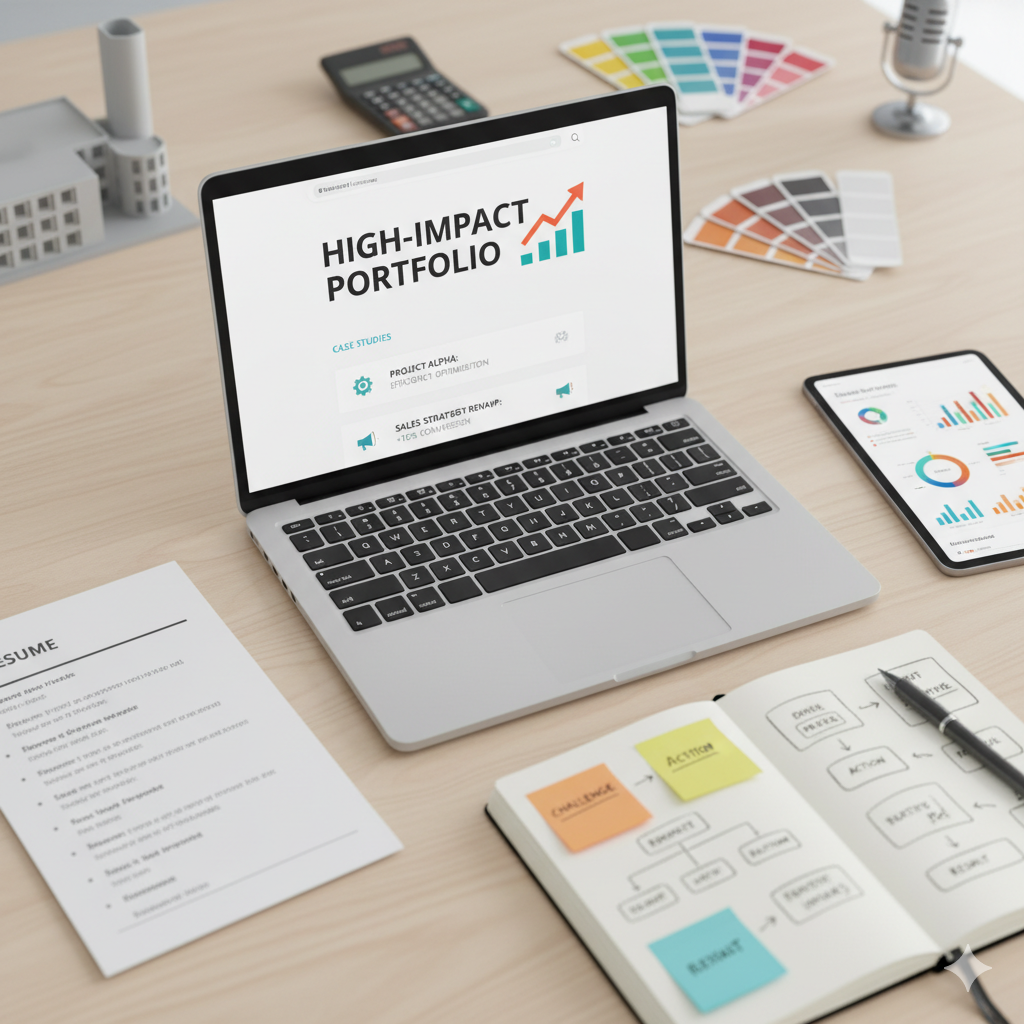
The days of the one-page resume being your only calling card are truly over.
In today’s competitive job market, an employer doesn’t just want to read about your accomplishments, they want to see them in action.
While portfolios were once exclusive to designers, photographers, and writers, they have become the secret weapon for professionals across all sectors, including finance, operations, human resources (HR), project management, and sales.
If you want to prove your intrinsic value and stand out from a stack of identical resumes, you must move beyond the traditional document and build a portfolio that showcases your real-world impact and process.
Why Your Resume Isn’t Enough Anymore.
A resume is a historical document listing past roles and responsibilities. A portfolio, on the other hand, is a proof of concept—it demonstrates your ability to solve future problems.
The Resume Problem
Resumes rely on generic action verbs and bullet points that rarely provide context or evidence. Phrases like, “Increased efficiency by 15%” are common and expected, but they offer zero evidence of how you achieved this result or what challenges you overcame. A hiring manager has to take your claims purely on faith.
The Portfolio Solution
A portfolio provides the crucial context, process, and tangible results. It offers a clear, visual, or documented explanation of your methodology. Critically, it answers the fundamental question every hiring manager asks: “What will this person actually do for our company and how quickly can they start delivering results?”
Simply put, a portfolio transforms you from a claimant (someone who claims to possess specific skills) into a producer (someone who can prove they create measurable value).
Step 1: Identify Your “Showable” Work and Shift Your Mindset
You might initially believe you have nothing to show because your work isn’t visual like a design project. However, every professional role generates “showable” work. The key is shifting your mindset from thinking of a “deliverable” to conceptualizing a “case study.”
For a Project Manager, your showable work isn’t just the final product; it’s the process and oversight—an anonymized process map, a risk mitigation plan template, or key stakeholder communication examples.
For a Sales or Business Development professional, your value is shown through strategy and persuasion—a template of a successful cold outreach campaign you designed, a chart detailing your sales funnel conversion rates, or a brief narrative on overcoming a major client objection.
For Operations or HR, your focus should be on optimization and training—a Before and After graphic demonstrating the time saved or error reduction, the new employee onboarding checklist or handbook you created, or a training video script.
For a Finance or Data specialist, showcase your analysis and insight—a dashboard visualization you built to track key KPIs (in Excel, Power BI, or Tableau), accompanied by a three-sentence summary of the business insight it generated.
Step 2: Structure Your Case Studies with the CAR Method
The goal of every portfolio item is to tell a concise, high-impact story of success. Use the CAR method (Challenge, Action, Result) to structure your case studies for maximum clarity and engagement:
C – Challenge: Define the Problem
Briefly but clearly state the problem, obstacle, or measurable goal that existed before you got involved. This establishes the stakes for the reader.
Example: “Our department was spending an estimated 15 hours per week manually generating and cross-referencing sales reports, leading to frequent errors and delayed business decisions.”
A – Action: Detail Your Process
Detail the specific, strategic steps you took to address the challenge. Be a process expert here. This is where you demonstrate your unique skills and methodology, not just the outcome. Focus on the tools you used and the decisions you made.
Example: “I researched, selected, and implemented an automation script using Python, trained three team members on the new data input procedures, and designed a standardized data visualization dashboard in Google Sheets for real-time tracking, ensuring accessibility across departments.”
R – Result: Quantify Your Impact
Quantify the outcome using numbers, percentages, or time saved, and connect this achievement back to a larger company goal or strategic objective. Results must be measurable and relevant.
Example: “This action reduced manual reporting time by 80% (12 hours saved weekly), eliminating errors, and freeing up team members to focus on high-value client relations, which contributed to a 5% increase in client satisfaction scores over the next quarter.”
Pro-Tip on Confidentiality
Hiring managers understand that you can’t share sensitive company information. Never use real client names, financial statements, or proprietary data. Instead, you have two great options:
Anonymize Your Work: Change company names, locations, and substitute real figures with realistic, rounded numbers (e.g., change ‘$3.2 million’ to ‘a multi-million dollar budget’).
Create a Simulated Project: Develop a case study that solves a common, well-known problem in your industry. For example, a financial analyst could create a budget optimization plan for a fictional non-profit organization. The hiring manager is primarily interested in seeing your process and thinking, not the exact numbers.
Step 3: Choose Your Platform and Go Live
You absolutely do not need to be a professional web designer to create an impressive portfolio. The platform you choose should prioritize ease of use and clean presentation.
Google Sites
This platform is ideal for non-design roles, simplicity, and easy integration with your work. It is completely free, professional-looking, and allows for easy embedding and linking to documents, spreadsheets, and presentations saved in Google Drive. It requires virtually no coding knowledge.
Notion
This is a powerful choice for those with text-heavy, process-focused case studies. It creates a clean, minimalist, database-like structure. Use its toggle and database features to organize complex case studies, allowing the reader to expand sections and drill down into the details they care about most.
LinkedIn
If you prefer to avoid a separate website, you can use the Featured section on your profile as a simple portfolio hub. Upload PDFs of your key case studies directly or link to detailed articles you’ve published on LinkedIn that outline your project processes, making it easy for recruiters to find.
Final Essential Step: The Call-to-Action (CTA)
A great portfolio is a sales tool. Once a hiring manager is impressed by your proven impact, do not make them search for your contact information or wonder about the next step.
At the bottom of every single case study and prominently on your main portfolio page, include a short, simple, and direct Call-to-Action:
“Ready to see this level of impact on your team? Let’s connect for a brief call to discuss your current needs.”
Your Next Step
Your professional portfolio is your most powerful career tool to professional power-up.
To avoid overwhelm, start small: choose your single best accomplishment from the last year, structure it immediately using the CAR method, and upload it to a free platform like Google Sites. Once that one case study is live, you’ve already gained a massive advantage over the competition who are still relying solely on their static resume.
www.gtrerahosing.com for reliable and affordable web hosting services.