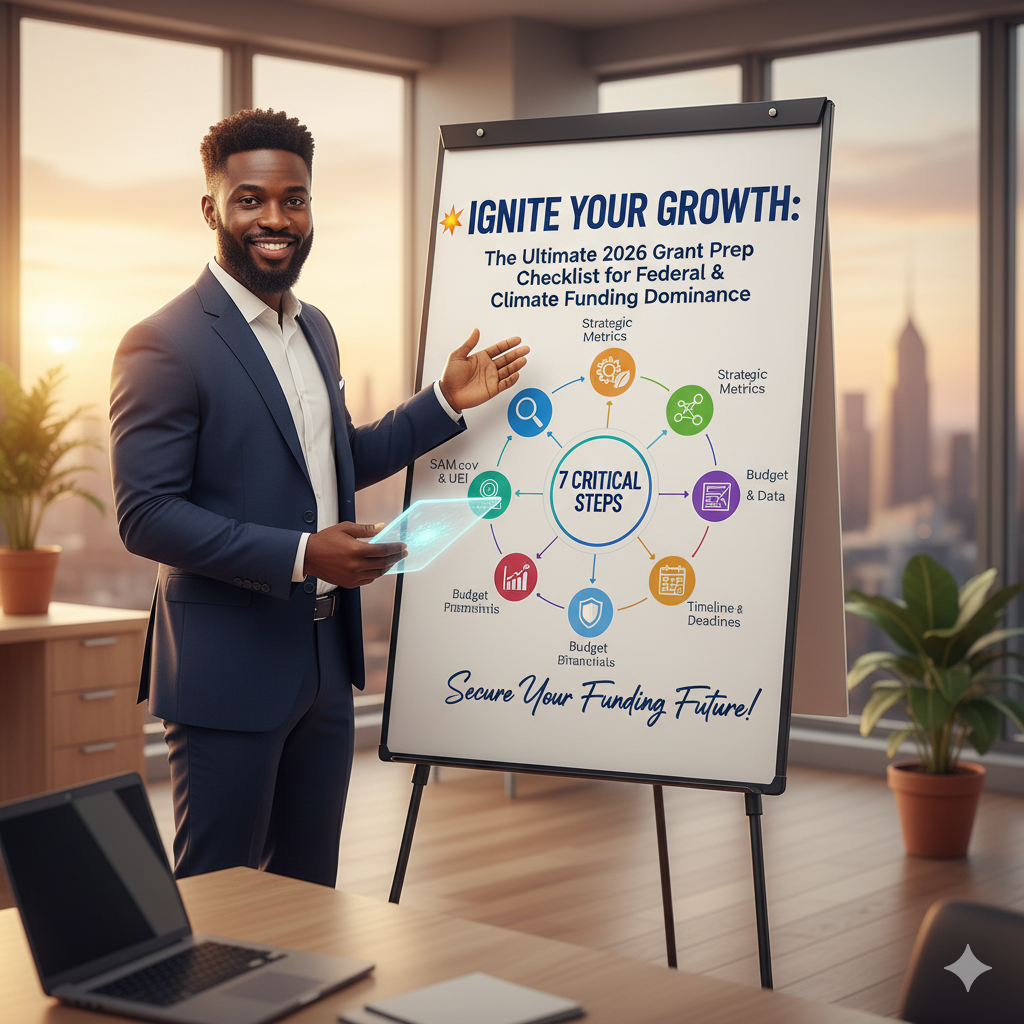
how you can secure Grant in 2026.
Ignite Your Growth: The Ultimate 2026 Grant Prep Checklist for Federal & Climate Funding Dominance.
The ambition to transform an innovative idea into a thriving enterprise often hinges on securing the right capital.
For visionary small businesses eyeing the explosive green economy funding landscape of 2026, the traditional wisdom of “waiting until January” for grant opportunities is a surefire path to being left behind. In the competitive world of non-dilutive funding, the window for winning major federal and foundational grants doesn’t open in January—it decisively closes. For climate-tech startups and sustainable infrastructure contractors, November and December are not just the end of the year; they are the most strategically crucial months for laying the groundwork to secure massive early-year federal grants for small business.
Your journey to securing critical climate solutions funding and government contracts for green businesses in 2026 demands proactive readiness, meticulous planning, and an understanding that the funding race has already begun.
This isn’t just a checklist; it’s your comprehensive roadmap to becoming an authoritative, prepared, and fully compliant candidate.
Here’s your ultimate 2026 small business grant preparation checklist, designed to transform your readiness and position you to dominate the early-year funding landscape.
Section 1: Demystifying the Digital Bureaucracy: Your Mandatory Federal Grant Credentials
Many innovative small businesses seeking federal grants stumble not because their ideas lack merit, but because they fail to navigate the intricate administrative requirements. This digital bureaucracy is the gatekeeper to climate solutions for small business funding, and mastering it now is non-negotiable.
The Unique Entity Identifier (UEI) Renaissance: The nine-digit alphanumeric Unique Entity Identifier (UEI) is your enterprise’s digital fingerprint within the federal system, having officially replaced the old DUNS number. You cannot apply for a federal grant without it. Crucially, your UEI for grant application is automatically assigned to you when you complete your primary registration in SAM.gov. Pro-tip: Don’t chase a UEI separately; prioritize your SAM.gov registration first. This step is the bedrock of all federal funding eligibility.
Conquering SAM.gov: Registration & Annual Renewal: The System for Award Management (SAM.gov) is the indispensable database where your business must be registered to do business with the U.S. government, encompassing both contracts and grants. Registration is not a one-time task; it’s a mandatory, annual renewal. This process can take anywhere from 7 to 10 business days for initial validation, and often longer if there are discrepancies in your business information. Don’t underestimate this timeframe. Initiate your registration today. Furthermore, establish a strict calendar reminder for your SAM.gov renewal checklist, ensuring continuous eligibility. An expired SAM.gov registration can instantly disqualify you from a grant you’ve spent weeks preparing.
Unlocking Grants.gov: Your Application Command Center: Once your SAM.gov registration is active and validated, your next critical step is to register on Grants.gov. This platform serves as the official, unified portal for finding and submitting federal grant applications. Within your organization, you must designate an Electronic Business Point of Contact (EBiz POC) in SAM.gov. This individual holds the authority to authorize specific users within Grants.gov to prepare and submit applications on behalf of your business. Without this crucial linkage, even a perfect proposal cannot be submitted.
Proactive Funding Intelligence: Targeted Alerts: Don’t passively wait for opportunities to find you. Leverage the powerful search functionalities within Grants.gov to set up daily email alerts. Utilize highly specific keywords tailored to your niche. Think beyond just “climate grants.” opt for terms like “climate technology SBIR”, “sustainable energy small business grants”, “IIJA sub grants for private contractors”, “environmental justice funding opportunities”, or “resilient infrastructure innovation awards.” This ensures you’re among the first to know when relevant federal climate grants for startups or green technology funding for small business are announced.
Section 2: Forging Your “Grant Readiness” Fortress: Strategic Foundation Building
Federal agencies and large philanthropic foundations don’t merely award money; they invest in reliable partners who can execute transformative projects with integrity and efficiency. Your goal is to establish your small business as that indispensable partner.
The Power of the Boilerplate: Perfecting Core Documents: Streamline your future application process by creating a robust boilerplate document. This master file will house all your non-project-specific information, allowing for rapid customization when a new Funding Opportunity Announcement (FOA) drops. Key components include:
508 Compliance Plan: Crucial for federal grants, this plan details how your IT outputs and communications will be accessible to individuals with disabilities, ensuring compliance with Section 508 of the Rehabilitation Act.
Data Management and Sharing Plan (DMSP): Increasingly required by scientific agencies (e.g., NSF, NIH), a DMSP outlines how you will manage, share, and preserve research data, emphasizing transparency and reproducibility.
Organizational Conflict of Interest (OCI) Statement: Proactively address any potential conflicts that could arise during the project. This demonstrates ethical foresight and compliance readiness.
Detailed Budget Boilerplate: Develop a standard, customizable budget template. This should meticulously detail anticipated costs for personnel, fringe benefits, travel, equipment, materials, and potential sub-award costs, ready to be quickly adjusted for specific green economy grants 2026 requirements.
The 3 Cs Strategy: Quantifying Your Climate Impact with Precision: For any green economy grant 2026, vague promises of environmental benefit won’t suffice. Funders demand rigorous, quantifiable impact metrics. This is your chance to showcase the tangible value of your climate solution.
Carbon: Present a meticulously calculated estimate of total tons of \text{CO}_2e (carbon dioxide equivalent) avoided, reduced, or sequestered by your proposed project. Reference established methodologies where possible.
Cost: Clearly articulate the projected financial savings ($) for end-users, communities, or partner organizations resulting from your innovation (e.g., energy bill reductions, operational efficiency gains).
Community: Detail the direct and indirect social benefits. Quantify jobs created (and specify types), the number of individuals or households benefiting, and critically, how your solution specifically impacts underserved communities. This is paramount for tapping into the burgeoning environmental justice funding streams.
Cultivating Strategic Partnerships: The Consortium Advantage: Large-scale federal climate grants for startups frequently favor applications from consortia over single entities. This demonstrates broader impact, shared expertise, and greater capacity.
Identify Your Ideal Partners: Seek out a complementary non-profit partner to bolster your community outreach, social impact narrative, or demonstration project. Consider a university research partner to add scientific rigor, validation, and access to specialized equipment or expertise.
Secure Letters of Commitment Early: Do not wait for an FOA to drop. Initiate discussions and secure signed Letters of Commitment (or Memorandum of Understanding) from your potential partners before the application window even opens. These letters demonstrate pre-existing relationships and a solidified project plan, significantly strengthening your proposal.
Section 3: Crafting Your Narrative: Designing Your Grant Proposal Boilerplate for Impact
Even with all the credentials and strategic groundwork, your grant proposal itself must be a compelling narrative that can be swiftly tailored to specific Funding Opportunity Announcements (FOAs) released in Q1. This is where your ability to articulate your vision for sustainable development grants shines.
The Persuasive 1-Page Project Summary: Your First Impression: This is arguably the most critical component, as it’s often the first (and sometimes only) section reviewers read in depth. It must be a succinct, yet powerful, narrative that:
Clearly articulates the pressing problem your small business climate solution addresses.
Presents your innovative solution with clarity and conviction.
Highlights the Intellectual Merit—the new knowledge, technology, or insight your project will generate.
Emphasizes the Broader Impacts—how your innovation will benefit society, the environment, or the economy at large, linking directly to national priorities.
The Robust Scoping Statement: Your Blueprint for Action: Develop a detailed, yet agency-agnostic, statement of work. This living document should meticulously outline the distinct phases of your proposed project, clearly define key deliverables at each stage, and present a realistic, data-driven timeline (e.g., 24-month, 36-month, or 60-month project plans). This demonstrates a sophisticated understanding of project management and execution.
The Power of External Validation: Gathering Current Support Letters: Don’t rely solely on your own claims. Proactively collect recent, compelling letters of support from influential external stakeholders. These could be potential clients or customers eager for your solution, policymakers advocating for your focus area, industry experts validating your technology, or community leaders endorsing your local impact. These letters are tangible proof of market readiness, community need, and external validation, significantly enhancing the credibility of your application for environmental sustainability grants.
By diligently completing this comprehensive grant preparation checklist in November and December, you fundamentally transform your small business. You transition from passively reacting to opportunities to proactively positioning yourself as an authoritative, impeccably prepared, and fully compliant candidate.
This strategic foresight for small business climate funding 2026 ensures you’re not just ready to compete, but poised to dominate the most competitive fully funded federal grant opportunities of the new year. Don’t simply wait for the new year; ignite your growth now. The funding race has already begun, and your readiness is your greatest asset.