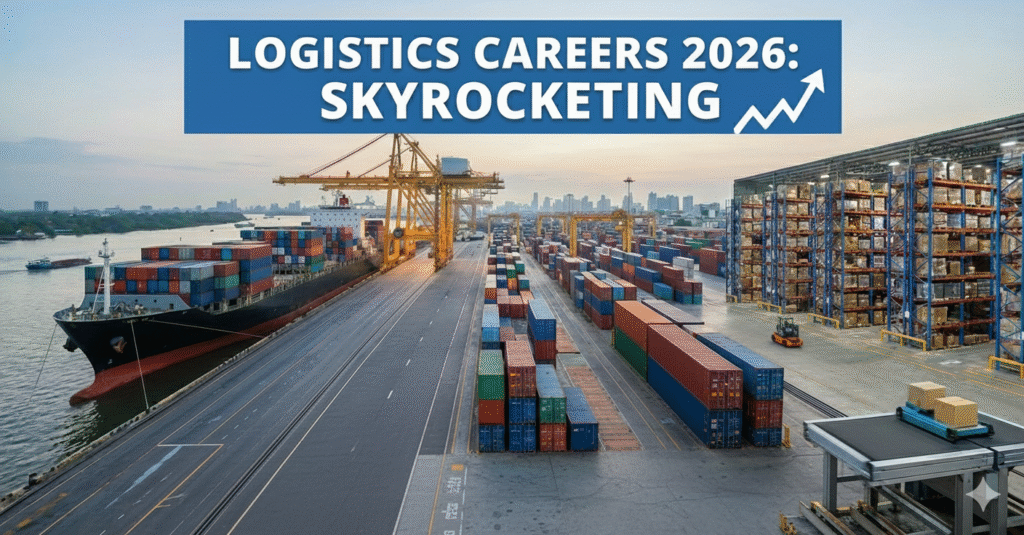
logistics careers
The global supply chain used to be invisible. Now, every person understands its vital, fragile importance. The events of the past few years have highlighted that a smooth economy does not run on code; it runs on trucks, ports, warehouses, and the sophisticated coordination that connects them all.
As of late 2025, the demand for logistics professionals is skyrocketing. The U.S. Bureau of Labor Statistics projects much faster than average growth for logisticians. What is particularly compelling for job seekers is the high earning potential coupled with a massive skills gap—a gap you can fill with targeted training and certifications, completely bypassing the traditional four year degree requirement.
If you are searching for high paying supply chain careers no degree or Certified Logistics Technician salary, you are looking at roles that offer median pay well over $80,000. These are the eight essential careers in Logistics and Supply Chain Management that are projected to dominate the job market in 2026, offering stability, high wages, and a clear path to leadership.
1. Certified Logistics Technician (CLT)
This is the foundational entry point into the advanced warehouse world. The role of the CLT is to manage the flow of materials, inventory control, and safety protocols within a distribution center or factory.
The modern warehouse is not the dusty building of the past; it is a high-tech ecosystem driven by robotics and automation. The CLT ensures that the human and robotic components work together seamlessly. They operate Warehouse Management Systems (WMS) software and oversee the receiving, storage, and retrieval of goods.
The Certification Advantage: The key to this role is the Certified Logistics Technician (CLT) credential, awarded by organizations like the Manufacturing Skill Standards Council (MSSC). It is often completed in just a few months through community college programs or online training. This certification serves as a universally recognized validation of competence, often allowing candidates to leapfrog those who only have a high school diploma. Entry level CLTs often see salaries starting around $50,000 to $60,000, with rapid growth potential.
2. Supply Chain Analyst
The Analyst is the brain of the operation. This role involves using data to predict demand, optimize inventory levels, and find the cheapest, fastest way to move goods from Point A to Point B.
You are responsible for analyzing large data sets related to sales forecasts, shipping costs, and production timelines. You use software to model different scenarios—for example, predicting the impact of a port closure or a sudden surge in consumer demand.
While a bachelor’s degree is often preferred, many companies are now hiring candidates with two to three years of experience in a lower-level logistics role (like Inventory Analyst) combined with a high-level certification such as the Certified Professional in Supply Management (CPSM). Analysts are crucial to profitability, with salaries starting comfortably in the $75,000 to $90,000 range.
3. Freight Broker Agent
A Freight Broker is a crucial intermediary. They do not own the trucks or the cargo; they simply connect a company that needs something shipped with a carrier that has space available. This is a pure sales and coordination role that requires zero coding and zero college.
A successful Freight Broker is a master negotiator and problem-solver. They are self-employed or work for a brokerage firm, and their income is commission-based, making the earning potential virtually unlimited. High performers routinely clear six figures.
The barrier to entry is low: you need a license (often state-based), insurance, and a surety bond. The real requirement is grit, communication skills, and the ability to build trust with both shippers and carriers. This role is pure entrepreneurship within the logistics world.
4. Import/Export Compliance Specialist
Every shipment that crosses an international border is subject to a complex web of tariffs, quotas, and government regulations. The Compliance Specialist ensures that the company does not incur massive fines or have its cargo seized.
This role requires extreme attention to detail and knowledge of international trade law. You manage documentation such as Bills of Lading, Customs Declarations, and Certificates of Origin.
Compliance roles are highly stable and highly valued. Specialized certifications in Customs Brokerage or International Trade from organizations like the International Compliance Association are often valued more highly than a general degree. In major ports and business hubs, these specialists are earning $85,000 and up.
5. Inventory Manager
The Inventory Manager has one goal: to have just the right amount of product on hand—not too much (which ties up cash) and not too little (which loses sales).
This is a dynamic job that requires strong analytical and supervisory skills. You manage a team, oversee forecasting software, and set the purchasing schedules.
Experience is King in this position. Moving from an Inventory Analyst role to an Inventory Manager role is the typical progression. The compensation for this mid-level management position generally ranges from $70,000 to $100,000, depending on the scale of the operation being managed.
6. Fleet Dispatcher
The Dispatcher is the air traffic controller for ground transportation. They are responsible for tracking all company vehicles, scheduling drivers, and ensuring compliance with federal and local hours-of-service regulations.
The work is fast-paced, high-pressure, and requires exceptional problem-solving skills, especially when dealing with unforeseen circumstances like road closures or mechanical breakdowns. The demand for highly skilled dispatchers is constantly rising alongside the e-commerce boom.
Experience in commercial trucking or a Certified Transportation Professional (CTP) designation is highly beneficial. Dispatchers for large national carriers and logistics firms command salaries well over $65,000, with high performers earning bonuses tied to efficiency.
7. Global Supply Chain Manager
This is the ultimate leadership role for the non-degreed professional who has climbed the ladder. The Global Supply Chain Manager oversees the entire lifecycle of a product, from raw materials sourcing in one country to final delivery in another.
While many in this role possess an MBA, the sheer experience gained from 10 to 15 years in logistics, combined with the Certified Supply Chain Professional (CSCP) certification, can open these doors. Companies prize real-world knowledge over academic theory for such mission-critical positions. Global managers often earn well into the six figures, sometimes exceeding $125,000, due to the complexity and strategic importance of the job.
8. Robotics and Automation Technician
As automation becomes standard in mega-warehouses, technicians are needed to maintain and troubleshoot the highly complex robotic systems. These robots move shelves, pick orders, and sort packages.
This job requires a mix of electrical, mechanical, and IT knowledge. It is a “blue collar tech” role. You do not code the robots; you fix them when they break down.
A two-year Associate Degree in Robotics or Industrial Maintenance, often combined with an apprenticeship, is the gold standard here. Because this is an emerging, specialized field, salaries are extremely competitive, easily pushing past the $70,000 mark.
The Strategy: Military and Certifications
If you are looking to enter this high-paying sector without a bachelor’s degree, focus on two pathways.
Leverage Military Experience
The military is the world’s largest logistics operation. Veterans transitioning from roles in supply, transport, or procurement are immediately highly valuable. Their experience is often accepted as equivalent to a college degree.
Invest in Certifications.
Certifications prove competence immediately. Unlike a degree that takes four years, a Certified Logistics Associate (CLA) can be earned in weeks. Targeting certifications like the CLT, CSCP, or CTP proves dedication and specialized knowledge, making you a ready-to-work candidate in an industry desperate for qualified hands. The future of high-paying, accessible work is in the supply chain. https://job.gterahub.com/ai-careers/